
SEO marketing can help local businesses become more visible when potential customers search for the products and services they provide. For many companies, those searches happen at exactly the right moment: the customer has a need and is actively looking for a business that can help.
However, effective search engine optimization involves much more than adding keywords to a website. Modern SEO combines useful content, technical website performance, local search optimization, authority, reputation, and an understanding of how customers actually search.
The strongest SEO strategies are usually built over time. Businesses that approach SEO as an ongoing marketing investment rather than a one-time project are generally in a better position to improve visibility and compete in valuable local searches.
What Is SEO Marketing?
SEO marketing is the process of improving a website and its overall online presence so that search engines can better understand the business and connect its pages with relevant searches.
For a local business, SEO may involve appearing for searches that include a city, neighborhood, service area, or phrases such as “near me.” It can also involve improving visibility in Google’s local results and Google Maps.
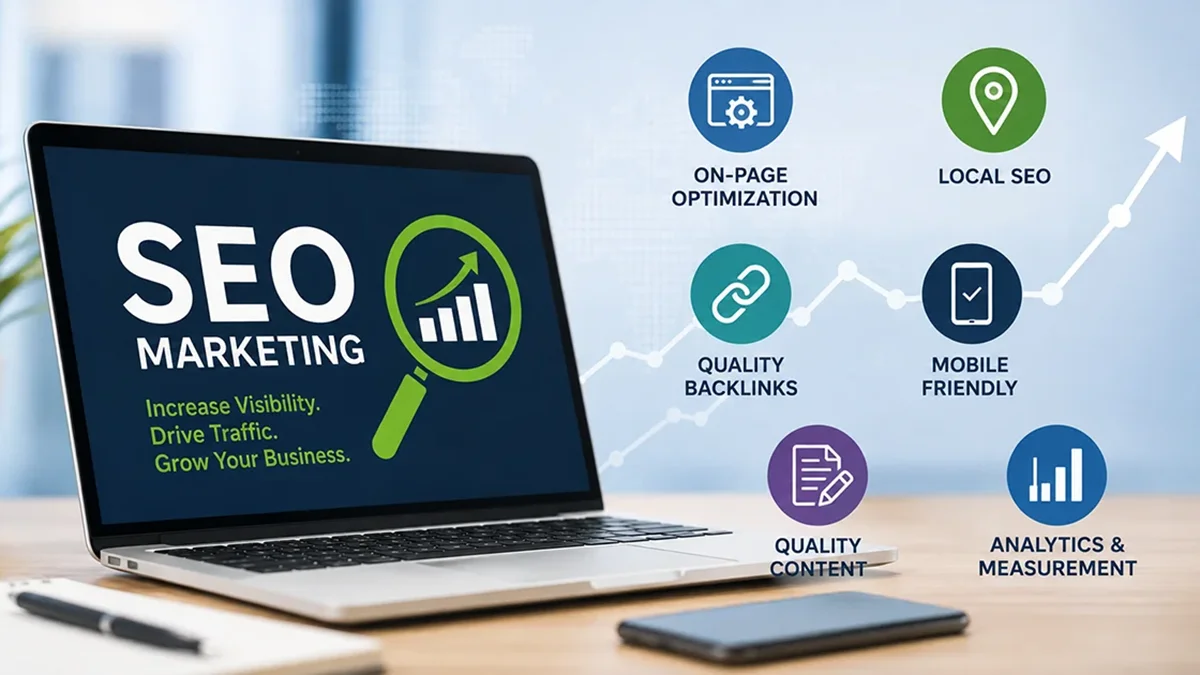
An effective SEO strategy may include:
- Keyword and search-intent research.
- Local SEO and Google Business Profile optimization.
- Useful service and location pages.
- Technical website improvements.
- Content development.
- Internal linking.
- Website authority and relevant backlinks.
- Online reviews and reputation signals.
- Conversion and traffic measurement.
These individual elements work best when they support one another.
Your Website Is the Foundation of SEO Marketing
Social media profiles, directory listings, videos, and other third-party platforms can all contribute to online visibility, but a business website remains an important foundation for SEO.
A company controls its own website. It can create dedicated pages for individual services, publish useful information, explain service areas, add photographs and videos, track customer activity, and make it easy for visitors to call or submit a contact form.
That level of control is difficult to achieve when a business depends entirely on social networks or other platforms whose rules and visibility can change.
A well-designed website should clearly explain:
- What the business does.
- Where it provides services.
- Why customers should consider the company.
- How to contact the business.
Professional website design and SEO should work together rather than being treated as completely separate projects.
Create Useful Content Around Customer Searches
Content remains an important part of SEO, but simply publishing large amounts of text is not enough.
Search engines increasingly attempt to understand whether a page actually satisfies the reason behind a search. That makes relevance, usefulness, accuracy, and organization more important than repeatedly inserting a keyword.
For a local business, useful content can include:
- Detailed service pages.
- Location and service-area pages.
- Frequently asked questions.
- Educational articles.
- Pricing or process information when appropriate.
- Project examples and case studies.
- Original photographs and videos.
- Information that addresses common customer concerns.
The goal should be to create pages that help a prospective customer understand the subject and make an informed decision.
Use Keywords Naturally
Keywords still matter because the language people use when searching can help identify what information should appear on a page.
However, modern SEO does not require repeating the same phrase over and over. Search engines can understand related terms, concepts, locations, and context.
A page about Houston air conditioning repair, for example, may naturally discuss HVAC systems, cooling problems, emergency repairs, thermostats, equipment, service areas, and other related subjects without forcing the exact same keyword into every paragraph.
Keyword research is most useful when it helps determine what customers are searching for and what information a page should provide.
SEO Titles and Meta Descriptions Still Matter
Every important page should have a clear SEO title and a useful meta description.
The page title can help search engines understand the primary subject of the page and may influence how the page appears in search results.
A meta description is not generally considered a direct Google ranking factor, but it can still be valuable because search engines may use it as the descriptive text beneath a search result. A good description can help a searcher understand why the page is relevant and encourage a qualified visitor to click.
Titles and descriptions should accurately represent the page rather than being written simply to contain as many keywords as possible.
Local SEO Is Especially Important for Service Businesses
Businesses serving a specific geographic market should consider local SEO as part of their overall search strategy.
Local SEO can include optimizing a Google Business Profile, maintaining accurate business information, developing useful location content, earning reviews, building relevant citations, and strengthening the relationship between the company’s website and the areas it serves.
For businesses competing in Houston and surrounding communities, a focused Houston local SEO strategy can help search engines better understand where the company operates and which services it provides.
Local search visibility is particularly valuable because many of these searches come from people who are actively looking for a nearby provider.
Technical SEO Helps Search Engines Access Your Website
Even strong content can underperform when a website has significant technical problems.
Technical SEO helps make sure search engines can crawl, understand, and index important pages while also providing visitors with a reliable experience.
Common technical considerations include:
- Page speed and website performance.
- Mobile usability.
- Secure HTTPS connections.
- Logical website navigation.
- Internal linking.
- Canonical URLs.
- XML sitemaps.
- Redirects and broken links.
- Structured data when appropriate.
- Duplicate or low-value pages.
Technical SEO does not replace good content, but it helps provide the foundation that allows useful content to perform properly.
Mobile-Friendly Websites Are Now a Basic Requirement
Mobile optimization is no longer an optional enhancement. Customers routinely use smartphones to search for businesses, compare providers, read reviews, call companies, request directions, and submit forms.
A responsive website should adjust properly to different screen sizes while keeping important information easy to read and use.
Buttons should be easy to tap, forms should work on smaller screens, telephone numbers should be accessible, and visitors should not have to zoom or scroll sideways to use the site.
Mobile usability is now simply part of providing a professional website experience.
Video Can Support an SEO Strategy
Video can be a useful addition to SEO and content marketing when it genuinely helps explain a subject.
A local business might create videos that:
- Answer common customer questions.
- Demonstrate a service.
- Show completed projects.
- Introduce employees or providers.
- Explain a process.
- Provide useful tips.
Video titles and descriptions should accurately describe the content. Trying to rank simply by forcing an exact search phrase into a title is less useful than creating a video that genuinely answers the searcher’s question.
Videos can also be incorporated into website pages and shared through social media, giving one piece of content several potential uses.
Online Reputation Can Affect Search Marketing
SEO marketing does not end when a business earns a search ranking.
A prospective customer may see the company in Google, examine its reviews, visit the website, compare it with competitors, and then decide whether to make contact.
That means reputation and search visibility often work together.
Businesses should monitor important review platforms, encourage legitimate customer feedback when appropriate, and respond professionally to reviews. Reviews can help potential customers evaluate a company and are particularly important in local search.
Links and Authority Still Matter
Search engines use many signals when determining which pages deserve visibility. One of those signals is the authority and reputation a website develops across the web.
Relevant backlinks from legitimate websites can help establish that authority. Useful links may come naturally from professional organizations, local publications, community involvement, business relationships, industry resources, or genuinely useful content that other websites choose to reference.
SEO strategies built around large numbers of low-quality or artificial links can create unnecessary risk. Quality and relevance are generally more valuable than simply accumulating the greatest possible number of links.
Measure SEO by Business Results
Search rankings can be useful indicators, but rankings alone do not determine whether an SEO campaign is successful.
Businesses should also evaluate metrics such as:
- Organic search traffic.
- Qualified website visitors.
- Telephone calls.
- Contact-form submissions.
- Appointment requests.
- Local search visibility.
- Conversions and leads.
A page ranking for a highly relevant search that produces qualified customers may be considerably more valuable than a page ranking for a broad term that generates traffic but no business.
SEO Marketing Requires Time and Continued Improvement
SEO is rarely an immediate process. Search engines need time to discover and evaluate changes, competitors continue improving their own websites, and the search environment itself changes constantly.
Businesses should periodically review important pages, expand useful content, correct technical problems, monitor search performance, and adjust their strategy as new opportunities appear.
The strongest SEO campaigns combine long-term consistency with ongoing improvement.
SEO as Part of a Complete Digital Marketing Strategy
SEO can generate valuable long-term visibility, but it does not have to operate alone.
Search engine optimization can work alongside Google Ads, content marketing, social media, reputation management, website improvements, and other forms of internet marketing.
Customers frequently interact with several of these channels before contacting a business. Someone might first see an advertisement, later find the company in organic search, read reviews, visit several website pages, and finally make a telephone call.
A coordinated strategy helps those different interactions reinforce one another.
ProEngage helps local businesses improve online visibility through SEO, website development, digital advertising, content, and other integrated marketing services.
SEO Marketing Questions
How long does SEO take to work?
There is no fixed timetable. Results depend on the competitiveness of the market, the condition and authority of the website, the searches being targeted, and the amount of work required. Some improvements may appear relatively quickly, while competitive local SEO campaigns often require continued work over a period of months.
Does a local business need a website for SEO?
A business can appear in certain local search results without a sophisticated website, but having its own website provides substantially more control over services, content, locations, conversions, tracking, and overall search visibility. For most businesses, the website should serve as an important part of the SEO strategy.
Do keywords still matter for SEO?
Yes, but they should be used naturally. Keyword research helps businesses understand how customers search and what information pages should contain. Modern SEO focuses more on relevance, context, and satisfying search intent than repeatedly using an exact phrase.
Is SEO better than Google Ads?
They serve different purposes. SEO can build long-term organic visibility, while Google Ads can create immediate paid exposure for selected searches. Many businesses benefit from using both, particularly when paid search and SEO data are used to improve the overall marketing strategy.
Can SEO help a business appear in Google Maps?
Local SEO can help improve a business’s overall presence in Google’s local search results. Google Business Profile optimization, relevance, reviews, website signals, prominence, and the searcher’s location can all influence local visibility.